
Assessing the Transgenerational Association of Maternal Glucose and childhood Obesity, and the Role of Behavioral, and Environmental influencing factors
Introduction:
The development of childhood obesity begins very early in life, and even before birth. The predisposing factors include glucose intolerance during pregnancy and is associated with an increased risk of adverse pregnancy and fetal outcomes, including maternal and perinatal mortality. Also, high as well as low birth weight predisposes children to obesity through their adolescence and young adulthood. As a result, 19.3% of Indian children are obese by nine years and are prone to several diseases, including cardiovascular diseases, fatty liver disease, and type 2 diabetes mellitus (T2DM). Childhood Overweight/Obesity (OW/OB) results from an imbalance of calories consumed v/s expended, resulting in excess body fat. Several obesogenic behaviors that are highly correlated with fat deposition exacerbate caloric imbalance. These include consuming high sugar and low-nutrient foods, high–saturated fat foods; low levels of physical activity, and high levels of sedentary behaviors. Further, this disequilibrium is precipitated and exacerbated by shortened sleep duration and altered activity patterns, screen time, genetics, and interpersonal relationships. Many of these individual obesogenic behaviors are strongly influenced by the family and neighborhood environment through, for example, norm-setting, social transmission of preferences, and broader living conditions. Enabling factors in the families and neighborhoods can result in better engagement and involvement in obesity prevention efforts.
Aims:
This project aims to understand the association of alterations in maternal glucose metabolism during pregnancy with subsequent childhood obesity at nine years of age. We will further assess the contribution of the shared neighborhood, family, and behavioral factors.
Objectives:
- To estimate the association of maternal glucose intolerance with obesity in children at age nine and identify biological pathways mediating this association by evaluating the relative role of insulin secretion vs resistance; hepatic vs visceral fat; and lean mass vs adiposity in children.
- To estimate the contribution of behavioral and environmental factors in the development of childhood obesity and glucose intolerance.
- We will newly measure individual behaviors in children (diet, physical activity, sleep, stress), including dynamic lifestyles measured using wearable technologies, and quantify their role in the development of obesity.
- We will newly measure environmental (family and neighborhood) factors and quantify their role in the development of childhood obesity.
- To identify phenotypic clusters of childhood obesity and explore their correlates (behavioral, environmental, and biological).
- To integrate the contribution of behavioral and environmental factors in the development of childhood obesity into a theoretical framework for context-specific interventions.
Experimental design and methods to be used in addressing the research
In the proposed TAGORE study, we will use mixed methods, with two components. First, we will extend the follow-up of a family-based prospective cohort study by real-time assessment of diet, physical activity, and other health behaviors, the examination of biomarkers of essential nutrients, and measuring the influence of geospatial data on environmental factors. Next, we will supplement this with a qualitative study to inform further refinement of theory to aid in developing contextual interventions.
Data collection
Exposure assessment: We have assessed the glucose levels in pregnant women between the ages of 18–45 years who were less than 36 weeks of gestation in the MAASTHI cohort. In brief, women were scheduled for an Oral Glucose Tolerance Test (OGTT) upon completion of 24 weeks of gestation. After the overnight fasting state, we estimated the fasting and two-hour levels after ingesting 75 gms of oral glucose.
In the proposed study, all family members will complete a questionnaire, and we will assess the following risk domains:
Biological: The serum aliquots of pregnant women from 2962 pregnant women are stored in -80 degrees. In these samples, we will investigate potential biomarkers of obesity and insulin resistance. Obesity is characterized by increased adipose tissue mass storage of fatty acids and various biomarkers. We will also measure glucose and insulin levels in parents.
Behavioral: We will conduct diet assessments in children through multiple 24-hour diets recalls, and real-time assessments of physical activity. Also, we will obtain real-time daily reports of health behaviors. We will also measure healthy eating through biomarkers of essential nutrients.
- Using web-based technology for dietary assessment will aid in the form of audio-visual stimuli, real-time results, and validated responses.
- With the help of sensors in an activity tracker or a mobile, the app will record the speed and pace of activities like walking or running.
Environmental:
Family environment: Assessment of nutrition-related beliefs, parental stress- depression, housing, home resources, frequency of family meals, parent nutrition knowledge, and behaviors and parent personal skills, family support for physical activity, and location of television/monitor. In parents, we will assess anthropometry (waist circumference, BMI), blood glucose, insulin, alcohol and tobacco consumption, diet, and physical activity. We will also measure siblings’ waist circumference and BMI.
Neighborhood environment:
- For each participant, home neighborhood, diet and physical activity will be mapped. The field team will use GIS mapping equipment, procedures, and training protocols that are adapted from our past studies and literature. We will record the number of free and unrestricted public spaces available for the children to play. Also, other recreation centers within a 2 km radius will be noted.
- Walkability index: Walkability provides a glimpse of the built environment’s health, socio-economics, and overall livability of the area locality.
- Fast-food outlet density and proximity: Spatial distribution measures will be used to map the density and proximity of fast food/unhealthy food stores/vendors around the children’s residence.
Outcome assessment
We will assess childhood obesity through anthropometry, including skinfold thickness. In a sub-sample, we will measure insulin secretion and glucose tolerance.
Assessment of skinfold thickness: At each annual follow-up, and in the final year, when the children are aged nine years, we will assess Obesity through the sum of skinfolds (>85th percentile).
Air-displacement plethysmography (ADP): As a valid and reliable marker, we will assess ADP as the gold standard for assessing fat mass and fat-free mass. This involves measuring subject height, weight, thoracic (body trunk) gas volume, and air displacement.
Glucose tolerance and insulin secretion: OGTT measures of insulin secretion provide an adequate estimate of the first phase of insulin secretion in youth.
Insulin secretion vs Insulin resistance: We will assess the insulin levels using the HOMA at nine years in children.
Mentors and Collaborators
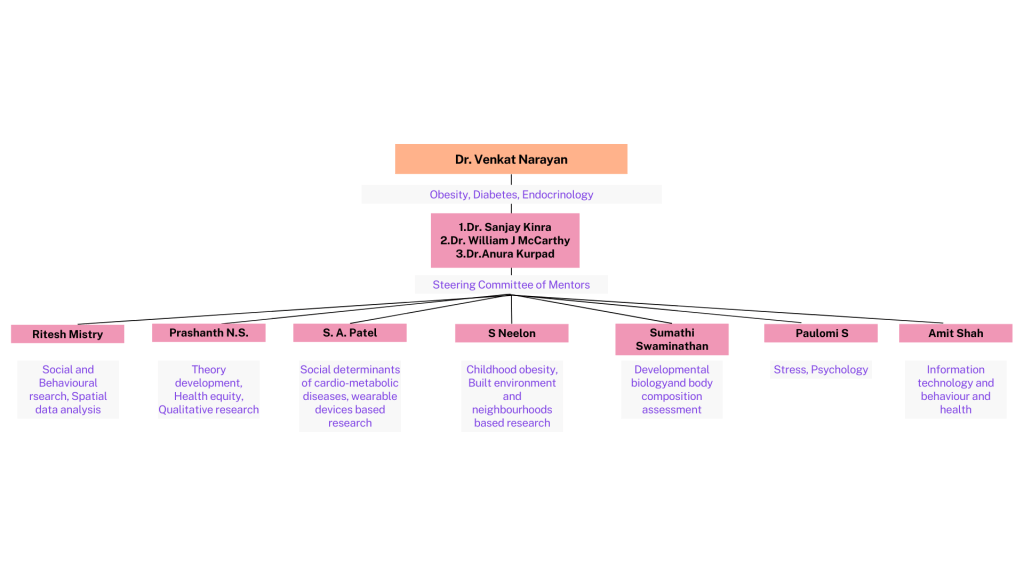
This research study is planned with the support from world class mentors and collaborators of high repute, both nationally as well as internationally. Keeping abrest with the latest developments in the field, with history of mentoring several senior level researchers.
Primary Mentor
Professor K M Venkat Narayan from Emory university, has rich research experience on diabetes and noncommunicable disease in public health. His current research involves exploring the intriguing differences in the pathophysiology of type 2 diabetes in South Asian and other developing countries globally. A major share of the study mandates researcher with rich experience and knowledge on diabetes. Prof Venkat Narayan would be able to contribute significantly to the study with respect to the component of glucose levels estimation, analysis and so on.
Steering Committee of Mentors
The steering committee of mentors is chaired by Professor Venkat Narayan, and includes Dr. Sanjay Kinra from London School of Hygiene and Tropical Medicine, Dr. William J. McCarthy from UCLA Fielding School of Public Health.
Dr. Sanjay Kinra directs a longstanding field site called the Andhra Pradesh Children and Parents Study, which includes following a large cohort of individuals in rural and urbanizing India to understand the biological and societal risk factors of chronic diseases and develop innovative solutions to address them. Dr. Kinra has almost two decades of research experience in nutrition and other similar components in India. With London School of Hygiene and Tropical Medicine as his home institution and with specific locations in India as the research site, he has managed to link up with research scholars from diverse backgrounds both nationally as well as internationally. Thereby, he would facilitate the components of the study which would take place at an international level which would acquaint me with world class researchers who has worked on nutritional epidemiology as well as childhood obesity.
Dr. William J. McCarthy has devoted most of his 30-year career to intervention studies designed to encourage members of special populations to adhere to the nutritional advice in preventing obesity. He also has work experience on Obesity, Physical Activity and Nutrition. He has wide variety of research experience in the fields like health behaviour, health promotion, nutrition, obesity, physical activity, prevention and intervention etc., which makes him the ideal person to collaborate in tis research study.
Collaborators
Dr. Ritiesh Mistry from the University of Michigan’s research interests are in understanding how chronic disease-related health behaviors in youth are influenced by structural factors (e.g., socioeconomic structures, public policy), neighborhoods (e.g. community level risks and resources) as well as family factors (e.g., parenting). Understanding the neighbourhood would also involve spatial data analysis as well as a minor involvement in the social and behavioural aspects of interaction within the household as well as the neighbourhood. His skills on GIS can be used for mapping the destinations, fast food outlet density as well as proximity, etc.
Dr. Prasanth N.S has experience in conducting studies in food fortification, micronutrient availability and has achieved grants in understanding and developing interventions for healthy food consumption practices in the children. Tangentially, Dr. Prasanth would help in the research by contributing to the qualitative component of the study. This would also involve designing a theoretical framework based on contextually acceptable interventions, once the behavioural and environmental factors which lead to obesity are thoroughly understood from the research.
Dr. Anura Kurpad, founding dean of St. Johns Research Institute has spent the lion’s share of his research time in the field of nutrition. As the current study involves significant clinical and non-clinical components of nutrition, his command of nutritional physiology will serve as the base of the direction of this study. His pragmatic approach to the conduction of research will be of utmost useful in guiding the research forward. He will also provide support in terms of measuring body volume, density, and composition(fat and fat-free mass) using air-displacement Plethysmography as his lab is equipped with the facilities for measuring these. His expertise in the examination of bioavailability of nutrients can help in the evaluation of healthy eating which can be identified by biomarkers of nutrients.
Dr. Shivani A. Patel is currently the assistant professor at the Emory University. As a social epidemiologist by training, Dr. Patel has her research guided by overarching interest in describing and understanding disparities in cardio-metabolic disease morbidity and mortality globally, with particularly focus on South Asia. To that end, she investigates the role of ethnic background, contextual factors (such as historical undernutrition, urbanization, migration, geography), and early life disadvantage in influencing cardio-metabolic disease profiles. In this era of technological innovations, that are both productive and destructive, Dr. Patel’s research experience on the usage of wearable devices can be brought in for a productive purpose in the study. This technology can be used for monitoring physical activity levels in the children. This is relevant because physical activity level is proved to be a determining factor of obesity.
Dr. Sara Benjamin Neelon is from Johns Hopkins Bloomberg School of Public Health include domestic and global chronic disease prevention, epigenetic and environmental changes affecting child growth and development. She has also worked in research studies which involve interventions targeting parents and other caregivers to promote appropriate feeding of their children. Similarly she has also involved in research which evaluates the physical activity, access to green space, and neighbourhood safety. She has also been into research involving specifically to childhood obesity. Her research experience in the role of built environment and other relevant environmental factors can be useful in determining the roles of these factors leading to obesity in the childhood in this study.
Dr. Sumathi Swaminathan is currently involved in teaching and research at the St. Johns Research Institute, Bangalore. Her competent skills in anthropometry can be tapped in for the measurement of the anthropometric indices to determine levels of obesity in the children. Measurements specific to this research will include assessment of both biceps and triceps skinfold thickness. In the analytical aspects of research, other anthropometric measurements such as maternal weight gain, birth weight, which are involved also, would need the understanding of the techniques of anthropometric measurements.
Dr. Paulomi Sudhir from National Institute of Mental Health and Neuro Sciences would contribute her psychological skills in understanding the psychosocial factors in the mother that might determine the obesity risk in the offspring and the factors associated with mindfulness of food consumption in the school children. As psychological components and complex and diverse, it would require the genius of a researcher like Dr. Sudhir to understand the psyche associated with different patterns of food consumption. Since obesity is also involved with psychological issues, Dr. Sudhir will also focus on the specific reasons for the health behaviours associated with physical activity levels, screen time and unhealthy food consumption which would lead to obesity. She will also investigate the bio-psychosocial spheres of the developmental process which would lead to obesity in children.
Professor Amit Shah will provide complementary support to the work on technological components as well as the behavioural aspects related to health and well-being. Mobile based technology and real-time data collection of diet and physical activity are the areas that he can extend his support on this study as he has research experience in collecting data using wearable devices in his previous research works. Also, his experience in both health behaviour as well as web-based technology can be intertwined for the momentary ecological assessments using the LifeData application. His knowledge in the technological component can be very useful in the estimation of indices like the walkability index.
List of Paper publications
- Deepa R, Mandal S, Van Schayck OC, Babu GR. Vitamin B6 Levels and Impaired Folate Status but Not Vitamin B12 Associated with Low Birth Weight: Results from the MAASTHI Birth Cohort in South India. Nutrients 2023; 15(7): 1793
- Lobo E, Ana Y, Deepa R, et al. Cohort profile: Cohort profile: maternal antecedents of adiposity and studying the transgenerational role of hyperglycemia and insulin (MAASTHI). BMJ Open 2022; 12(9).
- Shriyan P, Sudhir P, van Schayck OC, Babu GR. Association of high cortisol levels in pregnancy and altered fetal growth. Results from the MAASTHI, a prospective cohort study, Bengaluru. The Lancet Regional Health-Southeast Asia 2023.
- Small babies, big risks: global estimates of prevalence and mortality for vulnerable newborns to accelerate change and improve counting; The Lancet-Small Vulnerable Newborn series; May 8, 2023 https://doi.org/10.1016/ S0140-6736(23)00522-6
- Vulnerable newborn types: analysis of sub-national, population-based birth cohorts for 541 285 live births in 23 countries, 2000–2021; BJOG-An International Journal of Obstetrics and Gynecology; ay 08, 2023 DOI:https://doi.org/10.1016/S0140-6736(23)00522-6
 MAASTHI